
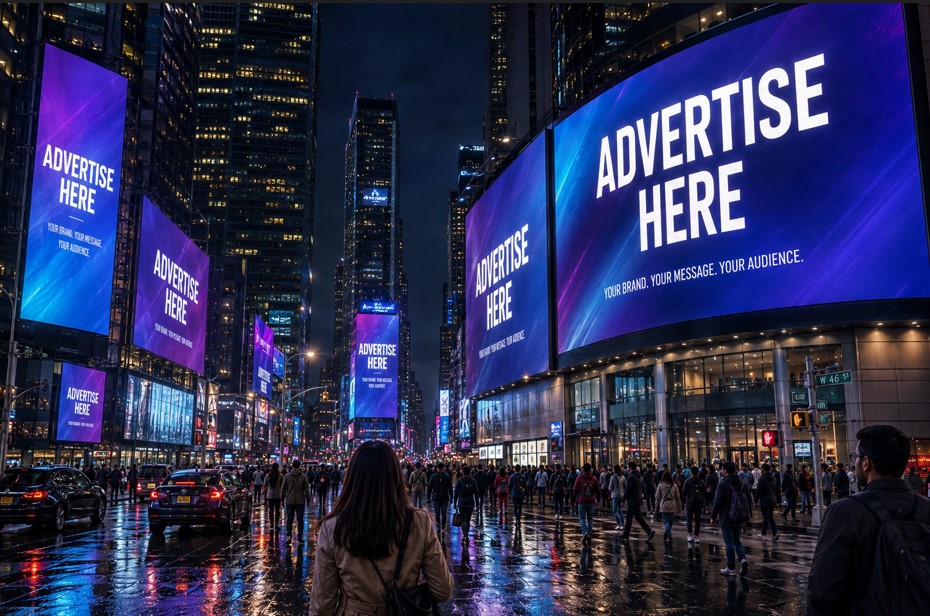
Walk past a regular billboard, and it barely holds your attention for more than a second, but when something responds to you, even in a small way, you slow down without really planning to, sometimes just out of curiosity, sometimes because it feels different from everything else around it, and that shift is where interactive outdoor advertising starts to show its value.
This article explores how these interactive formats are changing outdoor campaigns, with a closer look at augmented reality and the reasons why brands are leaning into them more than ever.
Understanding Interactive Outdoor Advertising
Traditional billboard advertising has always focused on visibility, with large visuals, clear messaging, and placements that guarantee steady traffic, which works well but keeps the interaction one-sided, where the brand delivers the message, and the audience simply passes by.
Interactive formats shift that dynamic by inviting some level of participation, whether it’s a screen that reacts to movement or a bus shelter that adjusts its content based on time or weather. So the experience feels less like something you pass by and more like something you engage with, even briefly.
Part of this comes from how digital advertising has shaped expectations, as people are used to tapping, swiping, and seeing instant responses. That mindset doesn’t switch off outdoors; it carries over into how they respond to physical media as well.
Attention plays a bigger role than anything, because people have become selective about what they notice. While static ads still do their job, interactive ones tend to hold attention just a bit longer, which is often enough to leave an impression.
What Is Augmented Reality Advertising?
Augmented reality, or AR, sounds technical at first, but the idea is quite simple. It places digital elements over the real world, often via a phone screen or display.
You point your camera at a street poster, and suddenly, there’s animation layered on top. A product might appear in 3D. A character could step out of the frame in a way that catches you slightly off guard the first time you see it.
For AR advertising to work, a few things need to come together. There’s the software that recognises images or locations, the content itself, and the device that displays it. Most people access AR through their smartphones, though some campaigns use interactive screens in public spaces.
What makes AR stand out is how it blends physical and digital space. It doesn’t replace the real world. It builds on it, which gives brands a way to tell stories that feel more connected to the moment, even in places where people are constantly on the move.
How Augmented Reality Is Transforming Outdoor Advertising
The biggest change is how static formats are being reimagined. A traditional billboard might show a product. An AR-enabled one lets you interact with it. You can rotate it, explore features, or see it in a different context.
There’s also a storytelling angle that feels more layered. Instead of a single message, brands can unfold narratives. A simple poster could lead to a short interactive journey. Not everyone will engage with it, of course, but those who do tend to remember it.
Another shift is participation. People aren’t just viewers anymore. They scan, tap, explore. Some campaigns even respond in real time, which adds a sense of immediacy that static formats can’t quite match.
It’s interesting, though, not every interaction needs to be complex. Sometimes a small, clever response works better than a fully immersive setup. There’s a balance to strike, and not every campaign gets it right.
Popular Formats of AR Outdoor Advertising
AR is appearing in different forms across outdoor advertising, and each format offers its own kind of interaction.
Digital billboards are the most obvious starting point. These can integrate AR triggers that connect with mobile devices. A passerby scans the screen and unlocks an experience that goes beyond what’s visible.
Bus advertising has also become surprisingly adaptable. Bus shelters now host interactive displays that react to movement or allow users to engage directly through touchscreens. Some even combine AR with live data, which adds another layer of relevance.
Posters and street installations are also evolving. What looks like a regular print ad can turn into something much more dynamic when viewed through a phone. It feels a bit like discovering something hidden in plain sight.
Location-based campaigns take things further. They use specific places as anchors for AR experiences. You might only unlock certain content in a specific area, creating a sense of exclusivity.
Benefits of Augmented Reality in Outdoor Advertising
- Higher engagement levels
People tend to spend more time with interactive ads, increasing the likelihood that the message will be noticed and processed. - Stronger brand recall
Interaction makes a difference, as people remember something they engaged with more than something they only glanced at. - More personal experience
AR creates responses that feel tailored to the user, which helps the message feel less distant and more relevant in the moment. - Increased social sharing
Experiences that feel different or unexpected are more likely to be shared, extending reach beyond the original placement. - Actionable audience insights
Interactive formats provide data on user behaviour, including engagement time and interaction patterns, which helps refine future campaigns. - Better value against outdoor advertising rates
When engagement and interaction are factored in, the overall return shifts beyond basic impressions, giving a clearer sense of campaign impact.
Where It Leaves Outdoor Advertising
It’s easy to assume that interactive formats will replace traditional ones, but in practice, both continue to coexist, often within the same campaign.
What’s shifting is how brands approach their presence in public spaces, where a static billboard builds familiarity over time, while an interactive format adds a layer of engagement that holds attention a little longer. When used together, they tend to support each other rather than compete.
There’s also a practical angle to keep in mind: not every location or campaign needs AR or interactive elements, and in some cases, a clear, simple message works better.
When interaction fits naturally into the setting, it can add something that standard formats don’t quite deliver.
Conclusion
Interactive outdoor advertising focuses on creating moments that people notice, engage with, and remember, adding a layer of involvement beyond passive viewing.
Not every campaign needs that level of interaction, but when used in the right context, it tends to leave a more personal impression that lasts a little longer.